
The Last Dragon's Legacy

If I were to ask, “Who’s the master?” without segue, I could be met with very different reactions in mixed company. But if just one person answered, “Sho’Nuff!”, I would have found my tribe. Why is this random person, who is more than likely Black, of my tribe? Because they would have known that I was referencing the 1985 cult classic film, Berry Gordy’s The Last Dragon. As a child, this film was all anyone in my limited circle could talk about. I say limited because as a child, your circle is mostly family, classmates, and whatever kid lives next door. Martial arts films have usually done well with Black audiences. And here was one that was immersed in Black culture. This movie is just about everything it can be in 1 hour and 49 minutes. It’s a Kung-Fu-fighting comic book video game set to an extremely 80s soundtrack with a commentary on racial identity. Wait, what?
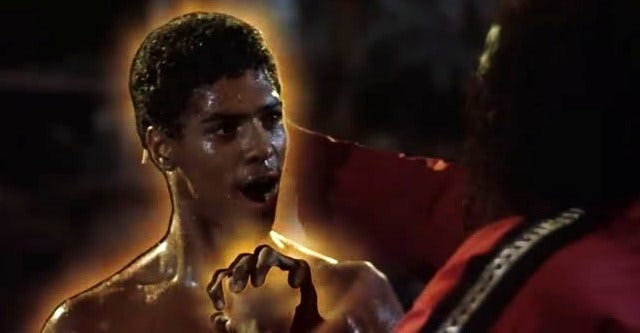
If you are of the camp that has no clue what I’m talking about, here is a quick breakdown of the movie. “Bruce” Leroy Green Jr, played by Taimak Guarriello, lives, breathes, and eats Asian culture, especially martial arts. Leroy, a timid soul, dresses mainly in Bruce Lee cosplay. I’m sure that brings its own set of problems in 1980s Harlem. His goal is to become a master martial artist who can channel The Glow's power. And this power is quite literal. His whole body will GLOW! Leroy has completed his training, so his sensei gives him a gold medallion that supposedly once belonged to Bruce Lee. Leroy needs to find Sum Dum Goy, who will help him find ultimate wisdom, thus receiving The Glow.
The neighborhood is very much aware of his martial arts talents. Legend has it that Leroy can catch bullets with his teeth! This pisses off the self-proclaimed master martial artist, Sho’Nuff. Sho’Nuff, played by the late Julius Carry, likes to enter the scene using a call-and-response opening from his gang of misfits. Sho’Nuff challenges our young hero to fight for the title of total supremacy. Leroy is uninterested in fighting this man for street cred. While on this journey, Leroy meets TV video host, Laura Charles. Late Prince protege Vanity, aka Denise Matthews plays Laura. Leroy saves Laura from a possible kidnapping from deranged music producer Eddie Arkadian, and she offers Leroy a job as her bodyguard.
So now we have a nemesis, and a love interest, but where does the commentary on racial identity fit in? Leroy is a 20-something Black man living in Harlem, who has immersed himself in Asian culture. Even though it seems to be in a very authentic way, he never stops receiving grief for it. It starts at home with his younger brother, Richie, who constantly tells him he’s not Black enough to hang with him in public. And, of course, Sho’Nuff makes sure to degrade Leroy each and every chance he gets. There’s a moment in the film where Leroy meets a group of Asian men hanging outside of the Sum Dum Goy fortune cookie factory. Ironically, these men have been immersing themselves in Hip Hop culture and are pretty sure they “got this.” They are rapping, break dancing, and my “soul brother” this and hand jive that. And in an act of pure self hate, they manage to throw in a few Asian racial slurs while talking to him. And then, they attempt to teach him how to be Black. The encounter is surreal and quite uncomfortable.
Even though things like this happen to Leroy often, the film doesn’t hit you over the head with it. It’s all very subtle. It’s something that I don’t even think I picked up on until many years later. What makes this silly movie so crucial to Black cinema is just that. This coming-of-age tale shows a young Black man trying to live his best life despite the people around him trying to force him into a box that makes them more at ease. Richie wants him to be “Blacker,” Laura wants him to lean into her sexual prowess, and Sho’Nuff, well, he just wants him to want to fight him really, really badly. Here’s the thing. Through all of this, Leroy manages to stay true to himself. There will be no makeover montage of Leroy becoming any of these personas others are trying to force on him. Although he does show up at the end in a rather dazzling white linen get up. The journey he was sent on was meant to be internal. The medallion was just a belt buckle! Leroy stays true to himself and his beliefs, and in doing so, achieves The Glow, figuratively and literally. He becomes a more fine tuned version of the man he already was. In doing so, he gains the respect of his brother, Laura stops pushing so hard, and Sho’Nuff gets his fight, but it’s for more than just street cred. Leroy was fighting to protect the people he cared about.
What makes this film a classic doesn’t have much to do with the technicality of the film. No disrespect to director Michael Schultz (Cooley High and Krush Groove) or to screenwriter Louis Venosta. Most of the dialogue is corny, Eddie Arkadian’s motivations seem extreme, the story is a bit clunky and I really need to know why Leroy speaks and behaves as though he just came out of a 10 year coma, last week. The classic part is what it means to the Black audience it was intended for. We could relate to Leroy, probably more than we could Daniel LaRusso in The Karate Kid, which was released the year before. Specifically, the young Black boys who grew up with a country labeling them as “aggressive'' and categorizing them as “men” by the time they hit 4th grade. Leroy recites a mantra: “Chinese Goju is my secret, and I bear no arms. May God help me if I ever have to use my art. Peace is our shelter.” We just want to keep our peace as our shelter. By the end of the film, it seems that Leroy was able to do just that.
**I was lucky enough to interview Taimak for my Down to Watch podcast while he was touring for the movie’s 31st anniversary and the release of his autobiography, Taimak The Last Dragon. You can listen here.